The problem
Two crowds, standing on either side of a shift, unable to reach each other.
This page is the argument the company is built on. It is deliberately specific about what is missing, because “connecting brands with creators” is a slogan until you name the six things that are actually absent.
The ledger
Six things a working market needs. None of them exist here.
Not one of these is exotic. Every mature creator market on earth has all six, provided by somebody. In Bangladesh they are simply absent, which is why deals die in “inbox please”.
| What's needed | What exists today | What's missing |
|---|---|---|
| A way to be found | DMs and luck | No directory, no filters, no way for a brand in Dhaka to find a trusted voice in Khulna. |
| A price | Whatever you dare ask | No rate card, no bands, no benchmark. Two identical creators quote figures 5× apart. |
| An agreement | A screenshot of a chat | No brief, no deliverable list, no revision limit, no usage rights, nothing enforceable. |
| Proof the audience is real | A follower count | No verification. Bought followers and real ones look identical from the outside. |
| Payment | A promise | No escrow, no dates, no recourse. Being paid late — or never — is normal, not exceptional. |
| Permission to be honest | Unspoken | Nothing protects a creator who says a product isn't good. So most of them stop saying it. |
The people aren't the problem. The missing bridge is.
It is tempting to blame one side — creators who ask too much, brands who pay too late. But both behave rationally given the infrastructure they have. Without verification you cannot tell a real audience from a bought one, so brands underpay everyone. Without escrow you cannot trust a stranger to pay, so creators demand advances and lose the deal. Fix the infrastructure and most of the bad behaviour disappears with it.
Creators who already make honest reviews for nothing, and would do it for a living if anyone asked.
Brands who know a credible stranger outsells an expensive face, and will pay for a hundred of them.
The shift
Trust left the producer and moved to the peer.
For fifty years persuasion in this country belonged to whoever could afford production: a camera, a jingle, a recognisable face, a slot on prime time. Trust was manufactured, it was expensive, and it worked because there was no alternative. Now there is one, and it lives in everyone's pocket.
42%
Still trust online reviews like a personal recommendation
Down from 79% in 2020 and a peak of 84% a decade ago. Anonymous review text is losing the credibility it once had.
2025 ·BrightLocal
1,026 US consumers on an online panel, published by a company that sells review-management software. No equivalent Bangladeshi survey exists.
88%
Trust people they know above every other channel
The most trusted source in the study, ahead of every paid format. Nielsen also found trust in advertising runs up to 20% lower in North America and Europe than in Africa, the Middle East and Latin America.
2021 ·Nielsen
Global study of 40,000+ consumers, now five years old, published by a company that sells advertising measurement. Bangladesh is not broken out.
+27%
TikTok's yearly growth in reach here
56.2 million adults, and 12.0 million of that added in a single year — more new reach than any other platform here gained. Short video is where the buying decision now gets made.
October 2025 ·DataReportal (Kepios · We Are Social · Meltwater)
Potential advertising reach from TikTok's own ad tool, adults 18+ only. Not comparable with Facebook's all-ages figure.
2.0m
Mobile financial service agents
Paying a creator in Kurigram is a solved problem. The infrastructure this marketplace needs already exists; the marketplace doesn't.
2025 ·Bangladesh Bank
Bangladesh Bank's own figure. The accompanying 250 million registered MFS accounts is a registration count, heavily duplicated against a population of ~176 million.
The search happens before the purchase
Money in hand, page open — and they stop, open another tab and type the product name and the word “review”. What they want is not information. It is a person who has already spent this money.
Amateur became a credential
Ordinary lighting, ordinary room, ordinary Bangla. The rough edge is not a flaw to be forgiven; it is the evidence that nobody bought the sentence. Somewhere along the way “amateur” stopped being an insult.
Polish now reads as a warning
The same audience watched the produced thing and the honest thing side by side in one scroll and learned which one told the truth. A perfectly lit product film does not fail because it is bad. It fails because it is obviously paid for.
Small audiences are not small
Two thousand people who ask you before they buy are worth more than two hundred thousand who scroll past. Every incentive in the current market prices this backwards, because follower count is the only number anyone can quote.
Nobody has ever believed a man in a lab coat pointing at a bar chart. They believe the neighbour who already bought the thing.
Which is inconvenient for advertising, and the entire opportunity here.
Why it persists
Six reasons the bridge never got built.
None of these are hard problems in isolation. They are hard because they only work together — verification without escrow still leaves creators unpaid, and escrow without verification just pays fraudsters faster.
01
Neither side can see the other
A brand can name three creators it has heard of. It cannot name forty in a category, filtered by region and language, ranked by whether their audience actually buys. That list has never existed, so campaigns default to whoever is already famous.
02
There is no price for trust
Follower count is the only number anyone can quote, so it becomes the price — which is exactly backwards. A creator with two thousand people who believe them is worth more than one with two hundred thousand who scroll past, and today there is no mechanism that says so.
03
Getting paid is the real job
Ask any creator here what the hard part is and they will not say the filming. They will say the four weeks of following up, the advance they had to demand, the brand that went quiet. Payment risk is the single biggest tax on this work, and it falls entirely on the person with the least power.
04
Honesty has no protection
A creator who says a product disappointed them risks the fee, the relationship and the next booking. So the market drifts towards praise — and audiences, who are not stupid, start discounting all of it. Everyone loses, including the brands paying for it.
05
Fakery is cheap and undetectable
Bought followers, bot comments and reviews of products nobody opened cost almost nothing and look, from the outside, exactly like the real thing. Without verification the honest creator competes on price against a fake one, and loses.
06
Nobody can run forty conversations
Even a brand that solves all of the above one creator at a time cannot do it forty times. Briefing, chasing, approving, invoicing and reporting across forty inboxes is a full-time job nobody has budgeted for, so campaigns stay small and the model never scales.
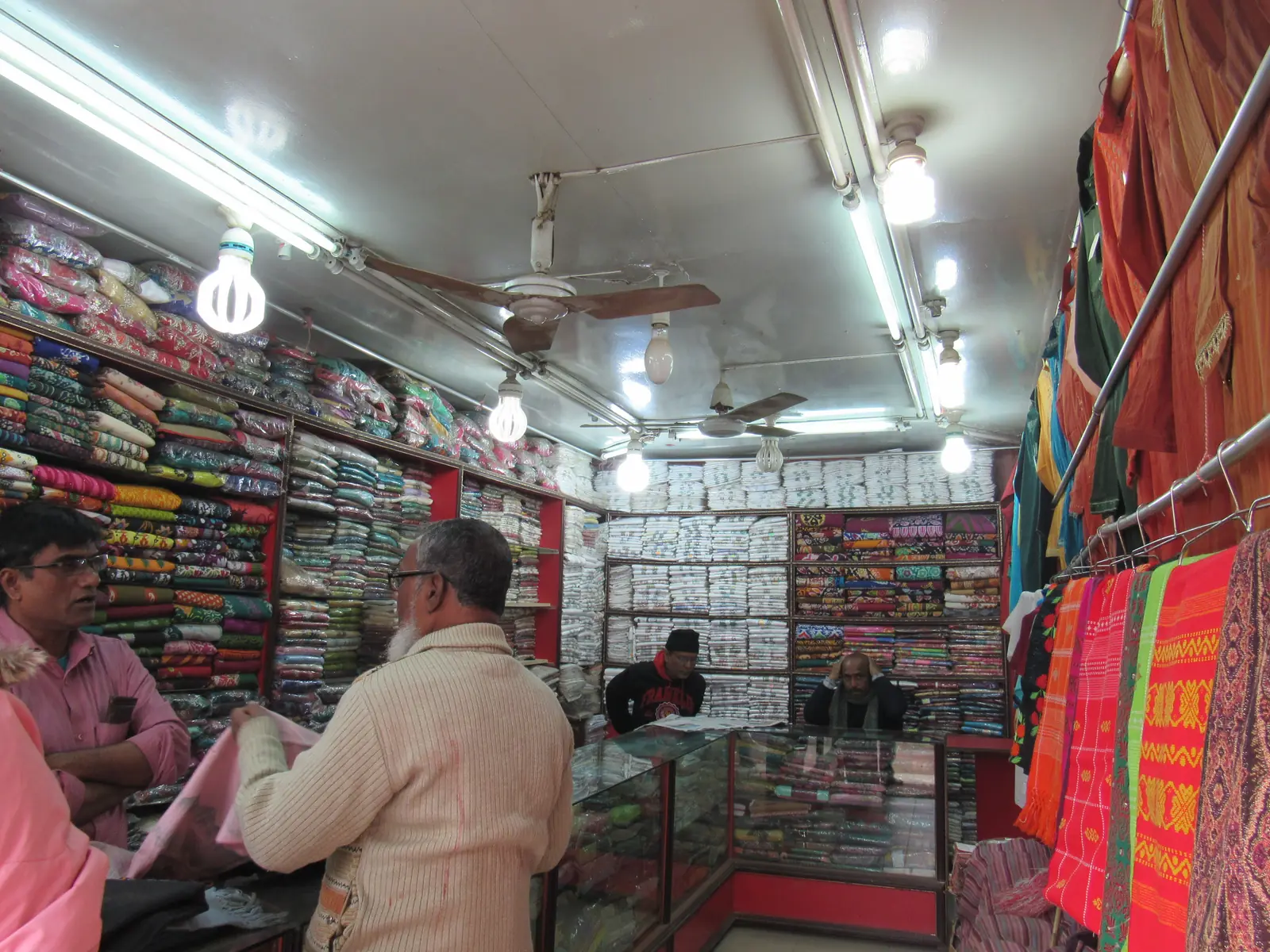
Khadi clothing shops in Kandirpar, Comilla. Every failure on this list falls hardest on the person with the least power in the transaction.
The cost
What the missing bridge actually costs, and who pays it.
The cost is not abstract. It lands on specific people, in specific ways, every week — and almost all of it falls on the side of the transaction with no leverage.
Verified
Every listed audience
Engagement quality, follower composition and account history — checked at signup and again after.
Our promise
Approve
Everything, before it goes live
Facts, format and claim safety are yours to correct. The verdict isn't.
Our promise
Reusable
Content, where rights are agreed
Usage terms are set in the brief, so the best pieces can run as paid creative too.
Our promise
Measured
Views, clicks, cost per result
Exportable, per creator, so the spend can be defended to whoever asks.
Our promise
The tax nobody has priced
A creator who does four brand deals a year and is paid late on two of them is not running a business — they are extending unsecured credit to companies larger than they are. A brand that gets burnt once by bought followers stops testing the channel entirely, and goes back to buying attention it knows doesn't work.
Meanwhile the audience — the only party nobody is negotiating with — quietly learns that reviews here are for sale. That is the real loss: not a bad campaign, but the slow devaluation of the one thing in commerce that still works.
Which is exactly why the first rule we wrote was about honesty, not growth.
Our numbers
Every figure on this site, and what is wrong with it.
Most companies in this position open with one enormous number about the size of the creator economy and hope nobody asks where it came from. We checked, and the honest answer is that for Bangladesh that number does not reliably exist: published estimates of the country's e-commerce market disagree with each other by roughly six times, none of them discloses a methodology, and all of them are paid vendor products.
If we cannot show the working, we do not print the number.
Our entire product is credibility. A platform that polices fake reviews cannot be loose with its own claims, and we are not going to be the first liar in our own marketing. So a figure appears on this site only if it is one of three things:
- A commitment we operate by — zero follower minimum, one hundred per cent disclosure, a fixed approval window, one invoice. These are decisions, so they are true on the day you read them, and you can hold us to them.
- Something we measured ourselves — on-time payment rate, accounts removed for fraud, disclosure compliance, median creator earnings. Published twice a year in an integrity report, including the numbers we would rather not print.
- A published third-party figure, with its caveat attached — BTRC, Bangladesh Bank, the Bureau of Statistics, DataReportal, e-CAB, Nielsen, BrightLocal. Each is shown with its publisher, its date and its limitation, because an ad-tool reach count is not a user count and a US review survey is not a Bangladeshi one. The footnote is part of the claim, not a hedge underneath it.
You will notice the sources sometimes disagree — BTRC counts 135.9 million internet subscriptions where DataReportal models 82.8 million users, because one counts active SIMs and the other counts people. We would rather show you that tension than quietly pick whichever number flatters us. If you want the reasoning behind any claim here, ask us directly and you will get a straight answer.
We don't manufacture trust. We find the people who already have it, and make sure they get paid for it.
What we do about it
The gap is the argument. The marketplace is the answer.
If the diagnosis holds, the fix is not more advertising — it is the missing infrastructure: discovery, briefs, verification, approvals, payment and proof, in one place.